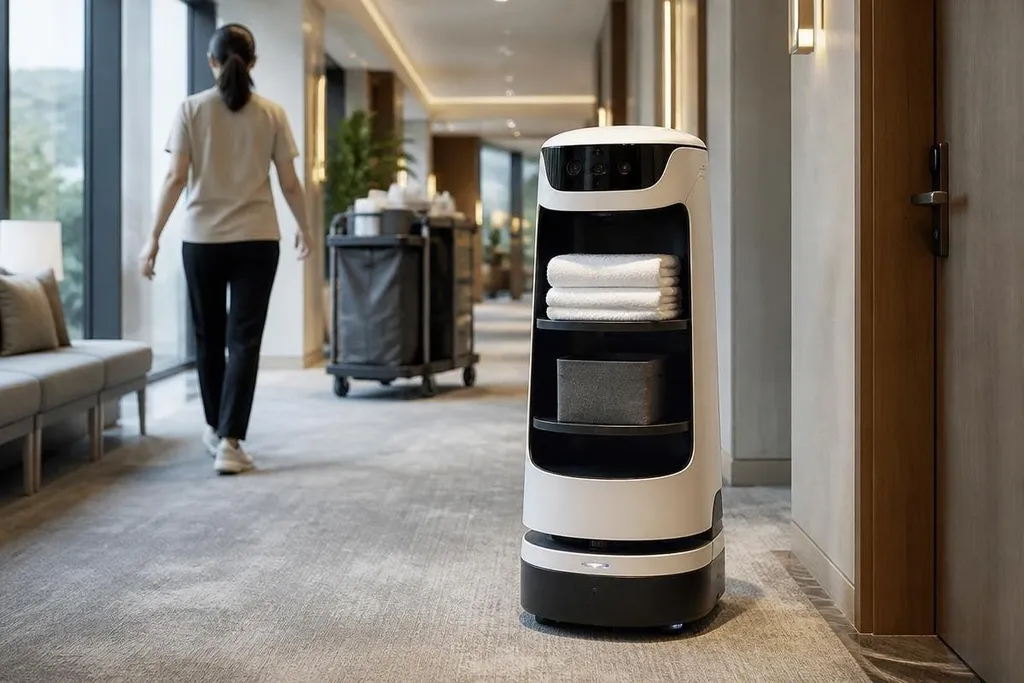
A service robot earns its place by finishing a task around people, furniture, doors, and changing light. The biggest gains have come from better movement, remote help, safer hardware, and software that lets one person manage several robots.
- Robots can build maps while they move through shared spaces.
- Remote operators can handle tasks the robot cannot finish alone.
- Fleet software turns separate machines into a system that people can supervise.
Movement that works outside the lab
A robot in a hotel, hospital, store, or office has to deal with routes that change during the day. People stop in doorways. Carts move. Chairs appear in places where the robot’s map shows open floor.
Modern service robots combine LiDAR, cameras, and wheel data to estimate where they are. LiDAR measures distance with laser pulses. Wheel data shows how far the motors should have moved. Cameras add detail about people and objects.
The gain comes from using those signals together. If one sensor gives a poor reading, the others can help the robot keep a usable position estimate.
That matters when a robot must reach the same delivery point many times without blocking a corridor. A map alone doesn’t solve the job. The robot also needs rules for speed, stopping distance, doorways, lifts, and people who change direction without warning. Those rules decide whether a demo becomes a service.
Remote help fills the hard gaps
Fully independent operation remains a high bar for service work. A delivery robot may handle a known route, then meet a closed door or an object that its software cannot identify.
Teleoperation gives a remote person a way to help. The robot can send video and sensor data, while the operator selects a route or confirms what the robot sees. The machine then returns to its normal task.
This setup changes the staffing question. One operator may help several robots if the requests arrive at different times. The result depends on the task, network connection, camera view, and the number of problems that need human attention.
The hard fact is that remote help doesn’t remove the need for good autonomy. If a robot asks for help every few minutes, the service costs too much.
The useful measure is how often help is needed, how long each case takes, and whether the robot can continue afterward.
Those measures also shape service robotics reporting: a task matters when the robot’s physical design and safety rules hold up in daily use.
Hands, bodies, and safety rules
Mobile delivery is easier than physical service. A robot that carries a tray has a narrow job. Picking up laundry, opening a door, or moving items between shelves needs control of contact, force, and grip.
That work has pushed progress in grippers, force sensors, depth cameras, and smaller motors. A gripper must hold an object without crushing it. A force sensor helps the robot detect contact. A depth camera helps it estimate the object’s shape and distance.
Safety also lives in the physical design. Rounded edges, limited joint force, visible stop controls, and slow movement near people reduce the harm caused by a software error. The exact safety plan still depends on the site and the task.
I’d rank reliable stopping and recovery above a flashy demo, because a service robot spends more time avoiding trouble than showing off a new motion.
Software makes a fleet useful
A single robot can be managed by hand. A fleet needs software that assigns jobs, reports faults, stores task history, and shows battery status. Without that layer, each robot becomes another machine for staff to check.
Fleet software also exposes the cost of failure. One missed delivery may waste a few minutes. A robot that blocks a lift or needs repeated operator help can affect staff work around it.
The open question is how much supervision each service can support. Makers can show a robot completing a task, yet buyers need records from normal operation: completed jobs, failed jobs, help requests, charging stops, and safety stops.
A practical buying check
Before you approve a service robot pilot, check these points:
- Name the task: write the start point, end point, object, and handoff.
- Count human help: record each remote intervention and the time it takes.
- Test the site: include doors, lifts, people, poor light, and blocked routes.
- Measure recovery: check how the robot reports a fault and resumes work.
- Price the service: include charging, network access, staff time, repairs, and software fees.
A useful breakthrough has a simple proof: the robot completes a repeatable task with fewer stops and less human help. Until a maker supplies those records from the place where you’ll run it, treat the demo as a test plan, not a purchase case.